The delay pedal placement question hits my inbox more than any other signal chain topic. And honestly, I get why it’s confusing. Every forum has a different “rule” about where delay should go, and half the advice contradicts the other half.
Here’s what I’ve learned after years of moving my delay around like a chess piece.
Delay pedal placement isn’t about following someone else’s diagram. It’s about understanding what actually happens to your sound when you put the pedal in different positions on your pedalboard.
The traditional delay pedal setup puts it near the end of your chain, right before reverb. That works great… until it doesn’t.
Sometimes that “textbook” delay pedal placement murders the character you’re after, turning your carefully crafted tone into digital mush.
So here’s how delay pedal placement changes your sound in each position, plus the framework I actually use to decide where mine goes. No rigid rules, no “this is the only way” nonsense. Just what works for your rig.
What Is a Delay Pedal and How Does It Work?
A delay pedal records your guitar signal, holds it for a set number of milliseconds, then plays it back so you hear the note again as an echo. Short times give you a tight slapback, a single repeat slapping against the dry note. Long times with the feedback cranked blur into cascading, ambient washes. Three controls do all the shaping: time (how long before the echo returns), feedback (how many repeats), and mix (how loud they sit against your dry signal).
That’s the whole trick. Everything else is just how far you push those three knobs.
I use mine for everything from thickening rhythm parts to building entire soundscapes, and the market is flooded with delay pedals that do it, from dead-simple analog boxes to digital monsters with a dozen modes. Want the full picture on how delay shapes your tone? Check out our complete Guitar Delay Pedals Guide.
Standard Delay Pedal Placement in the Effects Chain
The textbook delay pedal placement puts it near the end of your chain, and there’s solid logic behind this.
The standard approach goes like this:
Compressor → Gain → Modulation → Delay → Reverb.
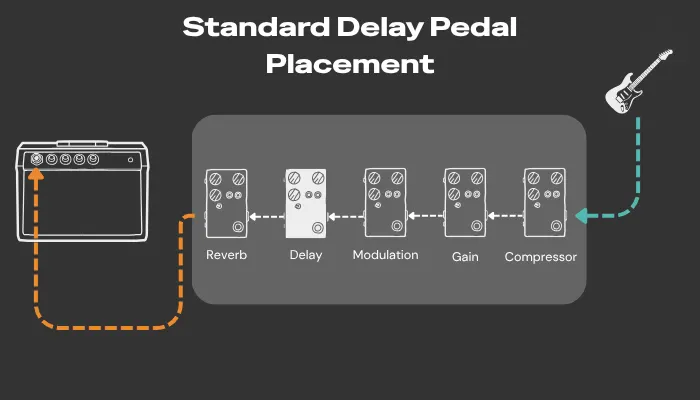
Putting delay after modulation means you’re echoing the fully-processed sound. Your chorus swirls stay intact in each repeat instead of turning into audio soup.
Delay before reverb is the default, and it’s worth knowing why. Delay makes the echoes, reverb puts them in a room. Each repeat generates first, then reverb wraps a little space around it, so your echoes stay articulate instead of drowning.
Run it the other way, reverb into delay, and you echo an already-spacious sound. The repeats get bigger and less defined, blurring into a wash. It can turn to mud fast, which is why most players don’t. But it’s a legitimate ambient move, not a mistake. If you want a cavernous, smeared soundscape, that’s how you build one.
But the standard chain assumes you want clean, pristine repeats. Sometimes you want chaos.
Learn the traditional placement first. It works for a reason, and you need to know the rules before you break them.
Delay Pedal Placement: Before or After Modulation and Distortion?
Delay pedal placement relative to your dirt and modulation is where things get interesting.
Before or After Distortion
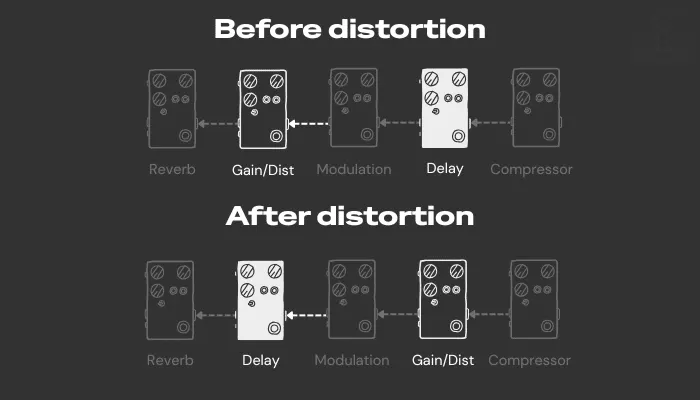
Most guitarists put delay after distortion for good reason: you’re distorting your dry signal, then adding clean repeats. Everything stays clear and articulate.
Delay after your dirt is where I live for lead sounds. Fuzz first, tightened up with a Klon-style clean boost (a klone), then delay last for the solo. The repeats stay clean while the fuzz does the sustaining. It’s creamy, it sings, and single notes hang forever.
But delay before distortion? That’s where things get weird.
When delay comes before distortion, every repeat gets pushed through your gain stages. It can sound like garbage. Muddy, undefined, like playing through a broken speaker.
Or it can sound incredible for that lo-fi, shoegaze wall-of-sound.
Before or After Modulation
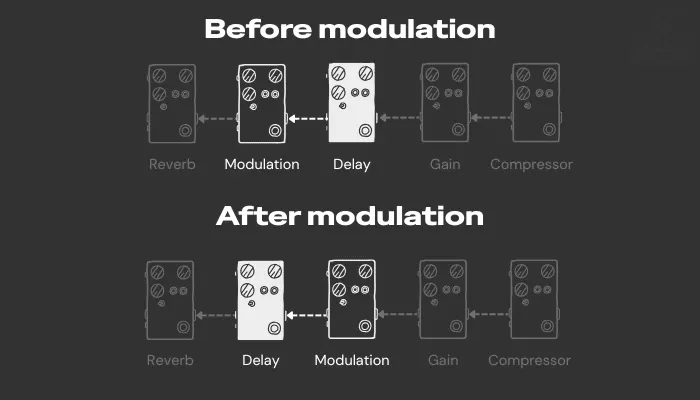
Placing the delay after modulation effects keeps things predictable:
- Your modulation adds character to your dry signal
- Delay captures that modulated tone perfectly
- Each repeat maintains those swirly textures
Put your delay pedal before modulation, and it creates rhythmic patterns that evolve with each repeat. Each echo comes back a little more warped than the last. Sometimes that’s the whole point.
Using the Effects Loop for Delay Pedals
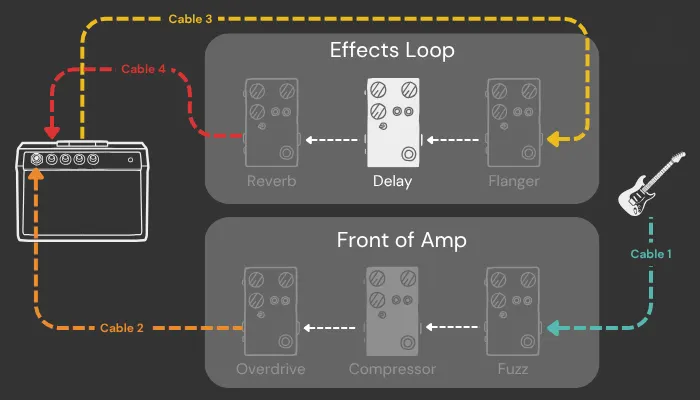
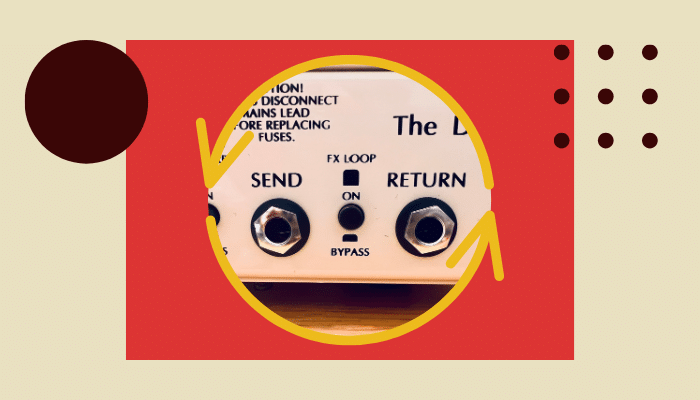
The effects loop is probably the most underused feature on most amps, and it decides where your delay pedal really wants to live.
Here’s my actual rule, and it comes down to which amp I’m plugged into. When I’m using an amp’s gain channel, like the dirt channel on my Bad Cat Black Cat, the delay goes in the effects loop. That puts it after the preamp, so the echoes ride on top of the distorted tone instead of getting shoved through the gain stage and smeared into mush.
Into a cleaner amp, my Victory Duchess V40 or a Fender Deluxe Reverb, I skip the loop entirely and go straight into the front. There’s no gainy preamp to muddy the repeats, so there’s nothing to work around. Front of amp, done.
That’s the whole decision. Cranking a preamp hard? The loop keeps your delays crystal clear. Running clean? Front of amp is simpler and sounds just as good.
Connecting it is dead simple either way. Cable from Send to your delay input, delay output back to Return.
Creative Delay Pedal Setups and Alternative Placements
Forget everything about “proper” delay placement. Some of the best sounds come from doing it all wrong.
Put your delay pedal before modulation and the repeats get progressively more warped with each echo. Run two delays in different spots and you build textures you can’t get any other way:
- Delay before overdrive gives you lo-fi, tape-saturated grit
- Delay after reverb creates massive, smeared washes
- Two delays in series with different times is instant U2
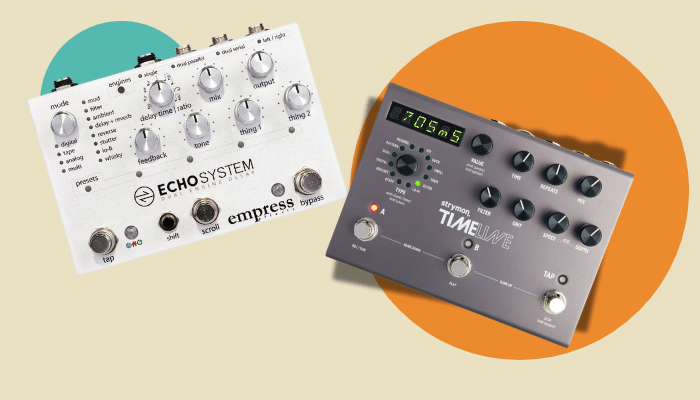
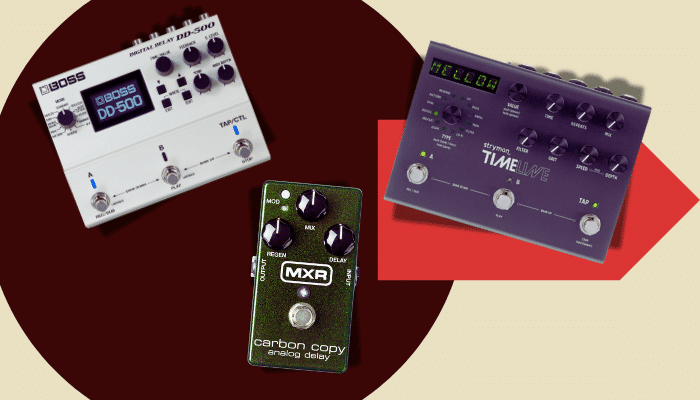
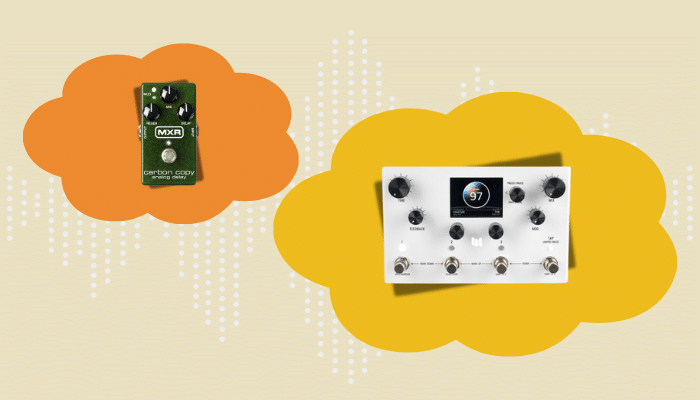
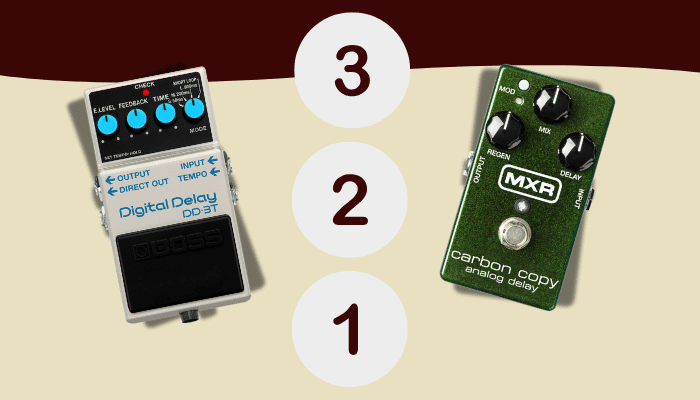
Here’s my actual board. I run an MXR Carbon Copy for a short analog slapback, set around 60 to 120ms, one quick repeat slapping against the note. At the other end I’ve got a Meris LVX for the atmospheric stuff, long multitap swells that bloom into a wash, and an Empress Echosystem for everyday delays and rhythmic patterns.
The rhythmic trick I lean on most is a dotted eighth note delay paired with a quarter note, set by tap tempo or MIDI clock if it’s a fixed song. Sometimes I split those across two pedals, sometimes I run both on the Echosystem. That dotted-eighth timing is The Edge’s whole thing, roughly 75% of a beat, about 356ms on Where the Streets Have No Name. Kick in the slap and the ambient delay together and you get a serious wall of sound.
The best part about creative delay pedal placement? There’s no wrong answer. That “mistake” might become your go-to sound.
How Delay Pedal Placement Affects Your Tone
Delay pedal placement doesn’t just change when you hear echoes. It alters the character of those echoes and how they interact with everything else in your signal.
Put your delay pedal at the end of your chain and you capture your fully formed tone. Every repeat sounds exactly like what you played, with all your effects intact.
Clean? Sure. Exciting? Not always.
Move that same delay pedal earlier and everything changes. Now your repeats get mangled by whatever comes after. Distorted, modulated, transformed with each pass.
The type of delay matters too. Analog delays add murky warmth that gets even murkier through distortion. Digital delays stay pristine no matter where you put them. Sometimes that’s exactly what you don’t want.
Here’s what actually happens to your tone:
- After modulation your delays capture the movement perfectly, each repeat swirling exactly like the original
- Before distortion you get instant vintage vibes, like running tape into a cooking tube amp
- In the effects loop the delays float above your core tone instead of mixing with it
The dirty secret: sometimes “worse” tone is better tone. Those muddy, undefined delays from “wrong” placement might be exactly what cuts through a dense mix.
Tips for Experimenting with Delay Pedal Placement
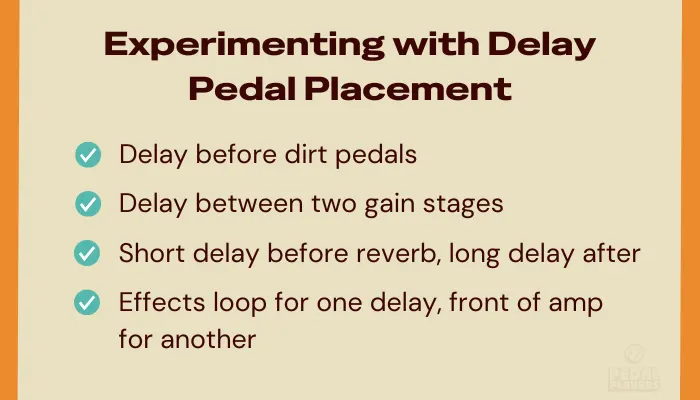
Pick a riff you know inside out, then move your delay to a different spot every time you play it. Or even better, loop it. Then all you have to do is listen.
Try these experiments:
- Delay before dirt pedals with cranked repeats, instant shoegaze
- Delay between two gain stages
- Short delay before reverb, long delay after
- Effects loop for one delay, front of amp for another
Take notes like “delay after fuzz = creamy singing leads” or “before chorus = seasick in the best way.”
Trust your ears over any guide. If it sounds good to you, it is good.
Want to move beyond basic delay settings? Explore How to Use a Delay Pedal: Advanced Techniques to master layering, modulation, and rhythmic depth like a pro.
Common Delay Pedal Placement Mistakes to Avoid
Let’s talk about delay pedal placement mistakes. Not because they’ll ruin your tone forever, but because I’ve made all of them and can save you some frustration.
The biggest “mistake” everyone warns about is placing delay before overdrive or distortion.
This only ruins your sound if you’re trying to get clean, articulate repeats. Sometimes muddy is exactly what you want. The mistake is doing it accidentally when you’re after clarity.
Real mistakes that actually matter:
- Running three delays and two reverbs all at once (spoiler: it’s audio soup)
- Ignoring your amp’s effects loop when running high gain, so you fight unnecessary noise
- Setting every time-based effect to the same tempo (congratulations, you’ve created mush)
The worst delay pedal placement mistake? Not experimenting because someone on a forum said there’s only one “right” way.
If your delay sounds like garbage and you don’t want it to, check: Is it before a high-gain pedal? Are you stacking too many time effects? Could the effects loop help?
Know the “rules” so you can break them on purpose, not by accident.
Every placement has its place. Even the “wrong” ones.
Finding Your Perfect Delay Pedal Setup
After all this talk about delay pedal placement, here’s the truth: your perfect setup is the one that makes you want to plug in tomorrow.
I’ve shown you the textbook chain, the rebellious one, and everything between. My own delay pedal setup looks nothing like it did five years ago, and that’s not indecision. That’s growth.
So start with standard placement. Learn why it works. Then break every rule on purpose until something magical happens. The best delay pedal placement discoveries come from happy accidents, and your “mistake” might be the sound that ends up defining you.