Last week I was talking gear at an open mic, the way you do between sets. A guy sidled over, half-hidden behind his pint, with the look of someone about to ask whether it’s normal to name your guitars.
“So, as an acoustic player,” he said, then stalled. “Can I… is it daft to…”
I waited.
“Do electric guitar pedals work on acoustic guitars?”
Not daft. It’s the right question, and almost nobody answers it honestly. I’ve been mostly an electric player my whole life, so every time I’ve heard effects on an acoustic, it’s been through electric pedals. I’d just never sat down and tested it properly.
So I went home, killed my weekend plans, and ran every pedal I own into an acoustic. Here’s what actually happened.
Key Takeaways
- Yes, electric pedals work on an acoustic. Reverb, delay, and a low transparent overdrive are the winners. Heavy dirt is not.
- Go subtle with the wet stuff. I keep reverb between 9:30 and 11 o’clock and a slapback delay short with the feedback low, just a couple of repeats.
- Keep overdrive gain under noon. Mine starts cooking around 11 o’clock, and a piezo squeals into feedback long before you reach the heavy end.
- My favourite dirt boxes flopped. A Blues Driver, Rat, Klon, and Bluesbreaker all flattened the acoustic’s natural character.
- Don’t put a cheap buffer first. A piezo wants a very high input impedance (around 10 megaohms), and most standard buffers sit at 1 and make it harsh.
- Buying new? Skip the electric pedals and buy gear voiced for acoustics.
Can You Use Electric Guitar Pedals on an Acoustic Guitar?
Yes. You can absolutely use electric guitar pedals with an acoustic guitar, and some of them sound fantastic. But the results swing wildly, and not in the way you’d guess. The pedals I was sure would work were the first to fall over.
Here’s the one thing to understand before anything else, and I’m only going to say it once. An acoustic’s pickup puts out a very different signal than an electric’s. Most acoustic-electrics use a piezo pickup under the saddle that senses the strings’ vibration, and it runs at a much lower output than a magnetic pickup. Most electric pedals are voiced for that hot magnetic signal. Feed them a quiet, brittle piezo signal instead and you get thin and glassy at best, an overloaded mess at worst. Sorry, neighbours.
That’s the whole theory. Everything below is what I actually got on the board.
The Electric Pedals That Actually Worked on Acoustic
Reverb and Delay: Start Here
Reverb and delay were the easy wins. Every reverb and every delay I tried sat happily on the acoustic without a fight. They add space and air without touching the core tone, which is exactly what a piezo wants.
For reverb I ran a TC Electronic Hall of Fame 2 (about £95) and a Strymon BlueSky (about £325, get the V2 if you’re buying new). Both were flawless. The trick is restraint. I keep the mix between about 9:30 and 11 o’clock for normal playing, just enough to add a bit of depth and stop the guitar sounding raw straight into a PA. I’ll push past that for something deliberately washy. But as a rule, add reverb until it sounds right, then pull it back a hair. You want to feel it more than hear it. Creeping the level up always leaves you with too much.
Delay was the same story. I used an MXR Carbon Copy (about £149), an Empress Echosystem, and a Meris LVX, and stuck to plain delays. No spacey nonsense. For a slapback I dial the time right down to a sharp single echo, which on the Carbon Copy is almost as low as the knob goes. Mix to taste, somewhere around 10 o’clock, the point where it just starts to wrap a halo around the note instead of doubling it. Keep the feedback low. One or two repeats, no more. Too much feedback turns a quiet acoustic into mud faster than anything else.
Transparent Overdrive: A Little Grit, No More
Heavy distortion and an acoustic are a bad marriage, and I’ll get to that funeral in a minute. But a transparent overdrive, set low, is a genuinely lovely thing on an acoustic. A touch of grit and sustain, the body of the note thickened, the character still intact.
My picks were the MXR GT-OD, the Greer Lightspeed, and the Xotic RC Booster Classic (the white one). All three did the job. The setting depends on your amp, so you’ll have to trial it, but on mine they start cooking around 11 o’clock on the gain. The catch is volume. As you bring the gain up the level jumps too, so balance the two until the grit kicks in without a great leap in loudness. Easier still, set one drive level you like and use the guitar’s volume knob to move between clean and pushed.
Past that sweet spot it all falls apart. Crank the gain and a piezo squeals. Loads of feedback, no clarity, every single thing I don’t like about high gain in one go. Great for ten minutes of chaos. Useless for a song.
The Pedals I Was Sure Would Work (And Didn’t)
Here’s the part I didn’t see coming. The pedals I’d have bet money on were the ones that let me down. My Boss Blues Driver, a ProCo Rat, a Klon, a Bluesbreaker. On an electric these are some of my favourite dirt boxes. On the acoustic they killed the thing that makes an acoustic an acoustic. That woody, resonant character just vanished, replaced with a honky, compressed version of itself.
They weren’t broken, and maybe someone out there loves a Klon on an acoustic for a specific noisy job. But for the sound I actually wanted, I couldn’t get anything I liked out of a single one of them. If you already own one, try it by all means. Just don’t be surprised when it flattens your tone.
The Buffer Trap Nobody Warns You About
This one cost me an afternoon, so let me save you the same fight.
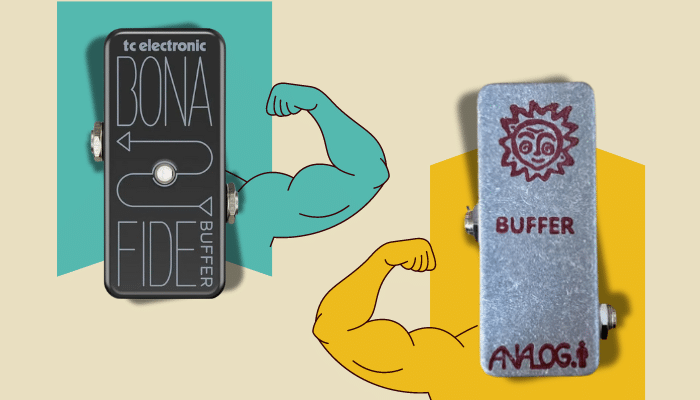
I run a Wampler dB+ as a buffer, and the first thing I did was stick it at the front of the chain, the way you would with an electric. My acoustic went instantly harsh and brittle. Genuinely unpleasant, like someone had scraped the warmth off the top. I tried the buffer in a Boss pedal in the same spot and got the same nasty edge.
The manual won’t tell you this, but there’s a real reason. A piezo pickup wants to “see” a very high input impedance, somewhere around 10 megaohms, to pass its full range. Most standard buffers and Boss pedals sit at 1 megaohm. That’s fine for a magnetic pickup and far too low for a piezo. Load that quiet, high-impedance signal down and you get exactly the thin, quacky harshness I was hearing.
A buffer can still help if you’re running long cables or a lot of pedals. Just don’t put a low-impedance one first in line with a piezo. If you need one up front, get a buffer or preamp built for acoustics that runs the high input impedance a piezo actually needs.
Putting the Chain Together
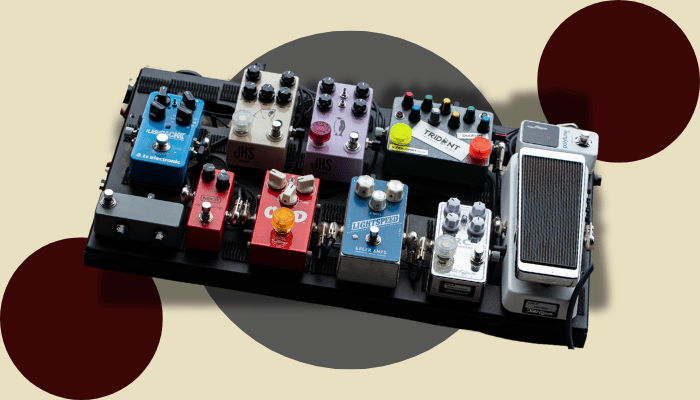
Keep it short. The more you pile on, the more hum and hiss a quiet acoustic signal drags along with it. The order I landed on follows the same logic as a standard electric board. Tuner first. Then drive, if you’re using any. Then modulation like chorus or phaser. Then delay and reverb last, so the ambience sits cleanly over everything else.
That’s a starting point, not gospel. Move things around and trust your ears.
If You’re Buying New, Just Buy Acoustic
Everything above is for the player who already owns a board of electric pedals and wants to put it to use. That’s the smart, free move. Go experiment, you’ll find a couple of gems.
But if you’re spending money fresh, don’t buy electric pedals for an acoustic. Buy pedals built for one. Plenty of makers now voice gear specifically for piezo-equipped acoustics, with the lower headroom and gentler EQ those pickups want.
L.R. Baggs, long known for acoustic pickups and preamp-DIs, makes the Align Series: pedals voiced for piezo acoustics, including the Session, Equalizer, Reverb, Chorus and Active DI. Boss makes proper acoustic preamps in the AD-2 and AD-10, and its old AC-3 acoustic simulator is still floating around used if what you really want is an electric faking an acoustic. Mooer’s tiny Acoustikar does that same simulator job for very little money, and Donner’s Alpha Acoustic bundles preamp, chorus and reverb into one box.

L.R. Baggs Align Series of Acoustic Pedals. Image from L.R. Baggs [1].
These save you every headache I just described. Lower headroom, EQ that flatters a piezo instead of fighting it, and no impedance surprises at the front of the chain.
Then Break All Of It
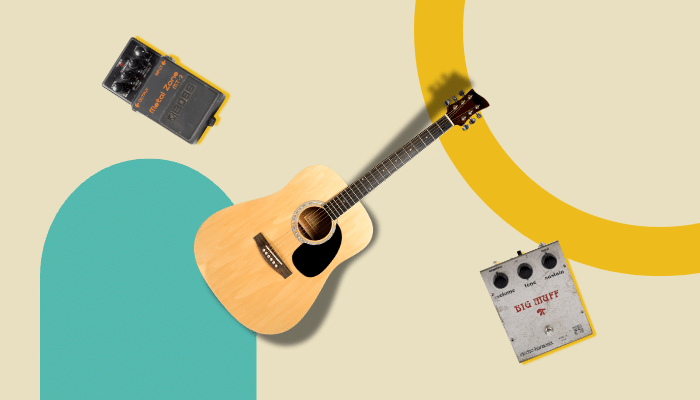
Everything I’ve told you is what worked for me, chasing a natural acoustic sound. None of it is a rule. Half the fun is ignoring me. Who’s to say you can’t run your acoustic into a Boss Metal Zone or a big fuzz and see what crawls out? I did. It was glorious, useless nonsense, and I enjoyed every second.
So here’s where I’d land it. If acoustic is your main instrument, buy pedals made for it and skip the headaches entirely. If you’re an electric player who picks up an acoustic now and then, the answer is already sitting on your board: reverb, delay, and a transparent overdrive set low. Start there. Keep the gain south of noon, keep the cheap buffer off the front, and let the guitar still sound like a guitar.