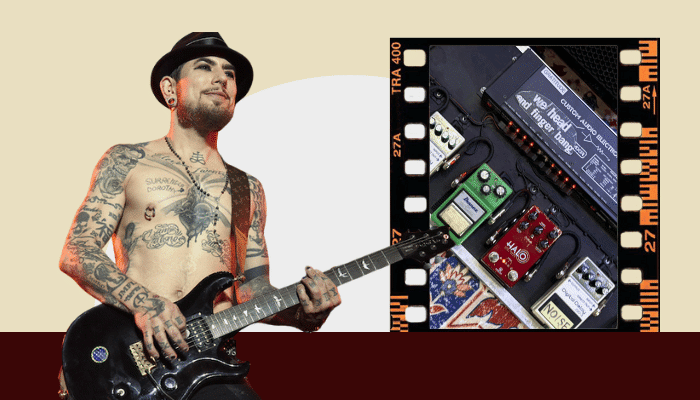
Imagine if you could recreate the same awesome tones that have become Dave Navarro’s signature across decades with Jane’s Addiction and beyond. For many alternative rock guitarists, that’s the dream.
Dave Navarro’s pedalboard isn’t just a collection of stompboxes. It’s the engine driving his versatile sound, which seamlessly transitions from hauntingly clean passages to blistering, psychedelic leads.
After carefully analyzing a picture posted of his 2025 pedalboard in a Facebook group, we’ve decoded the essential pedals powering his unmistakable tone.
From the pristine digital delays of multiple Boss DD-3s to the warm modulation of his CH-1 Super Chorus, every pedal serves a specific purpose in crafting his alternative rock soundscape.
In this guide, we’ll explore each pedal on Dave Navarro’s pedalboard and discuss how you might use these tools in your own setup.
Picture of Dave Navarro’s Pedalboard
The image I analyzed comes from a picture posted in a Facebook group. While not perfect quality, it reveals enough details to understand Dave Navarro’s pedalboard’s overall layout and pedal selection.
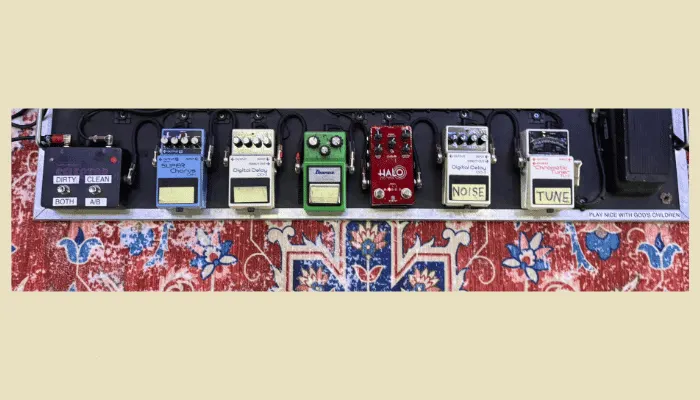
What makes Dave’s approach particularly interesting is his use of two distinct signal paths: one for clean tones and another for dirty tones, which he can switch between effortlessly during performances.
Clean Tone Signal Path
Dave’s clean tone signal path is remarkably straightforward, consisting of just two key pedals:
- Boss Digital Delay (DD-3)
- Boss Super Chorus (CH-1)
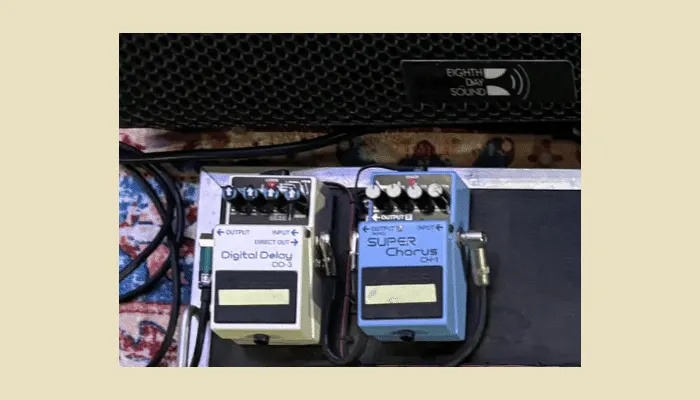
This minimalist approach to his clean tone allows for pristine, atmospheric sounds with just enough texture from the delay and dimension from the chorus to create Dave’s signature clean passages.
Dirty Tone Signal Path
Dave’s approach to his dirty tone signal path is a little more complex, but far from extensive.
It features multiple pedals working together to create his aggressive, yet articulate distorted sound:
- CryBaby Wah (exact model uncertain)
- Boss TU-3 Chromatic Tuner
- Boss Digital Delay (DD-3)
- Keeley Halo Delay
- Ibanez TS-9 Tube Screamer (likely used as a solo boost)
- Boss Digital Delay (DD-3) (a second unit in this chain)
- Boss Super Chorus (CH-1)
This carefully arranged signal path allows Dave to craft everything from mildly overdriven rhythm tones to soaring, delay-drenched leads.
Every pedal, explained
One section per pedal. How it's used, how it interacts with everything else, where the knobs sit.
Boss DD-3 Digital Delay
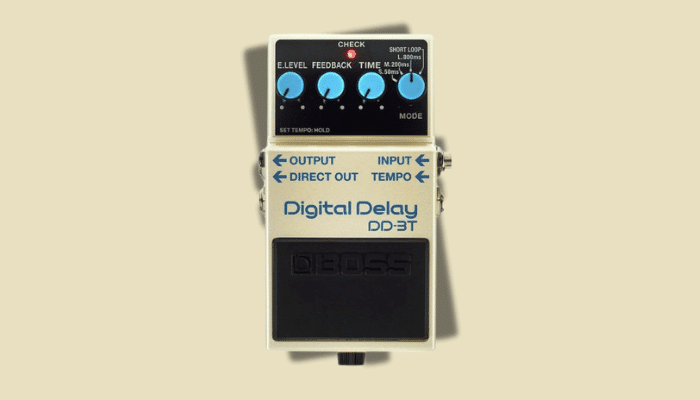
The Boss DD-3 Digital Delay is the cornerstone of Dave Navarro's sound — it appears three times across his two signal paths (once in the clean chain, twice in the dirty chain), which speaks to how central echo is to his sonic palette. Known for its pristine digital repeats and reliability, this compact pedal delivers studio-quality delay in a road-worthy enclosure.
The DD-3 offers delay times ranging from 12.5ms to 800ms, giving Dave plenty of options for everything from tight slapback echoes to more spacious ambient textures. With simple controls for Delay Time, Feedback (number of repeats), and Effect Level (mix), it's easy to dial in the perfect delay setting.
One particularly useful feature that Dave likely takes advantage of is the Hold function, which allows for infinite repeats of a delay sound — perfect for creating the swirling soundscapes that Jane's Addiction is known for.
By running multiple units with different settings, he can access various types of echo without bending down to adjust knobs mid-performance. In the dirty signal path, the two separate DD-3 pedals likely allow for different delay times and feedback — one set for a shorter, rhythmic delay to add dimension to rhythm parts, the other configured for longer, more pronounced echoes during solos.
Boss CH-1 Super Chorus
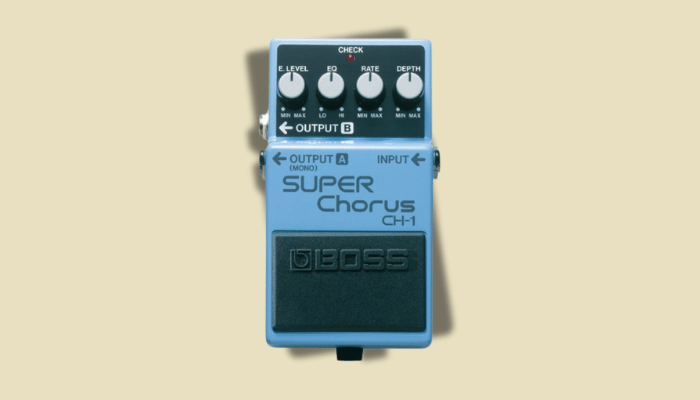
Following the delay in his clean signal chain is the Boss CH-1 Super Chorus, and it closes both of Dave's chains. This pedal adds shimmer and dimension to his clean tones with its crystal-clear highs and unique stereo effect.
The CH-1 features controls for Effect Level, EQ, Rate, and Depth, allowing for precise shaping of the chorus effect. It's versatile enough to sound great with both clean and overdriven tones, which is exactly why it also appears at the end of his dirty signal path.
What makes the CH-1 particularly useful for Dave's playing style is its ability to add movement and texture without overwhelming the core tone of his guitar — essential for maintaining clarity during intricate passages.
Placing it at the end of both chains ensures that all his clean or dirty tones can benefit from that dimensional quality. When used after distortion and delay, the CH-1 helps to widen and thicken the overall sound, creating that distinctive '90s alternative rock shimmer that defined much of Jane's Addiction's sound.
CryBaby Wah
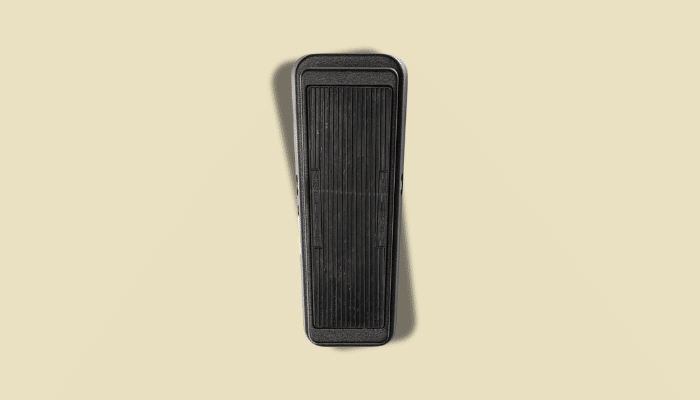
While the exact model of the CryBaby Wah pedal isn't clear from the image, this staple effect plays a crucial role in Dave Navarro's expressive playing style.
It looks like it's positioned at the front of his dirty signal chain, which allows him to add vocal-like wah-wah qualities to his guitar tone.
Dave often uses the wah subtly during rhythm parts to add movement, then more aggressively during solos to help his lead lines cut through the mix. The placement at the beginning of his chain ensures maximum response to his playing dynamics.
Learn how to use a Wah Pedal in How to Use a Wah Pedal: A Beginner's Guide.
Boss TU-3 Chromatic Tuner
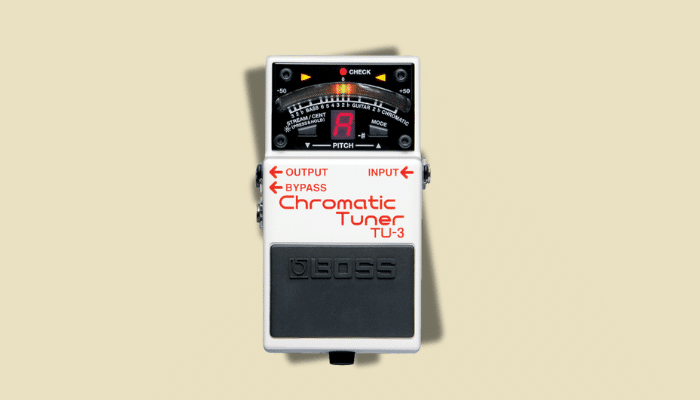
The Boss TU-3 is the industry-standard tuner pedal for good reason. With its 21-segment LED meter, high brightness mode, and +/- one-cent accuracy, it ensures Dave stays perfectly in tune throughout high-energy performances.
Beyond tuning, the TU-3 serves two other critical functions in Dave's setup. First, its buffer can help maintain signal integrity through his pedalboard. Second, the output mutes automatically when the tuner is engaged, allowing for silent tuning on stage or clean, noise-free pauses between songs. This is essential for any professional live setup.
The pedal also supports flat tuning up to six semitones below standard pitch, which may be useful for some of Jane's Addiction's lower-tuned material.
Keeley Halo Delay
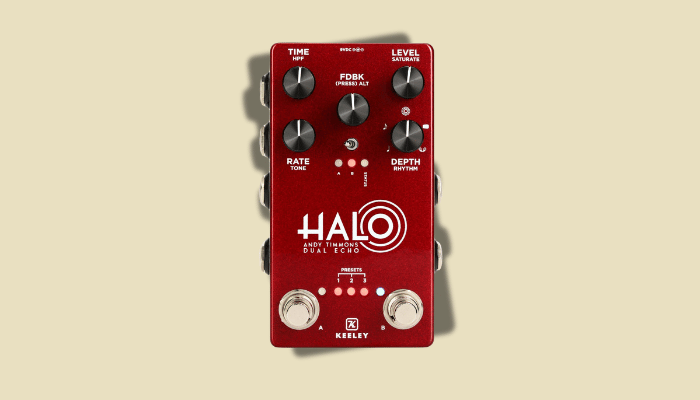
The Keeley Halo Delay is a signature Andy Timmons dual echo pedal that stands out as one of the more boutique offerings on Dave Navarro's pedalboard. This sophisticated digital delay offers unique features that expand Dave's sonic possibilities beyond what the DD-3s can provide.
With five distinct delay rhythms, including unique modulated dual-echo sounds, the Halo can create atmospheric textures that dance rhythmically, almost creating a reverb-like diffusion. It includes tape-style effects such as modulation, saturation, and compression, which are perfect for creating the ambient soundscapes that are featured in many of Jane's Addiction tracks.
The pedal offers delay times up to 1500ms and includes tap tempo functionality, making it extremely versatile for live performances. Perhaps most importantly, the Halo functions essentially as two delay pedals in one, with the ability to switch between sides A and B on the fly — giving Dave even more tonal options during a performance [1].
Ibanez TS-9 Tube Screamer
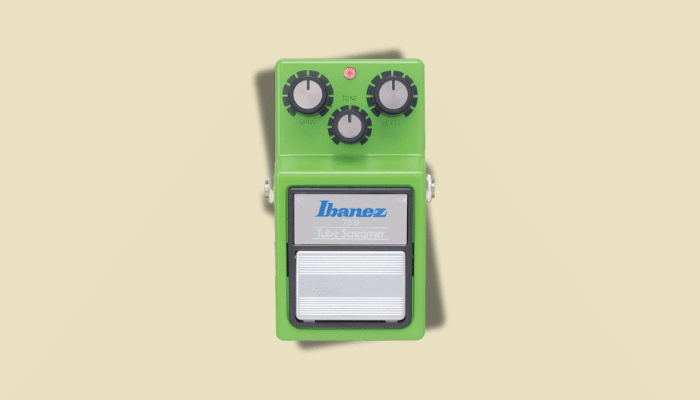
The Ibanez TS-9 Tube Screamer appears in Dave's dirty signal path, likely serving as a solo boost rather than his primary distortion source. This classic overdrive pedal is renowned for its mid-boosted tone that helps guitar solos cut through dense mixes.
With simple controls for Drive, Tone, and Level, the TS-9 allows Dave to push his already dirty signal with additional sustain and warmth when needed. The pedal's distinctive midrange emphasis would complement Dave's playing style perfectly, adding singing qualities to his lead work.
Given its position after some delay pedals but before others, Dave seems to be using the TS-9 strategically to boost certain delay effects while still allowing his final delay and chorus to process the boosted signal.
Interested in Tube Screamers? Check out our article Ibanez TS9 vs TS808.
Whirlwind Selector A/B Switch
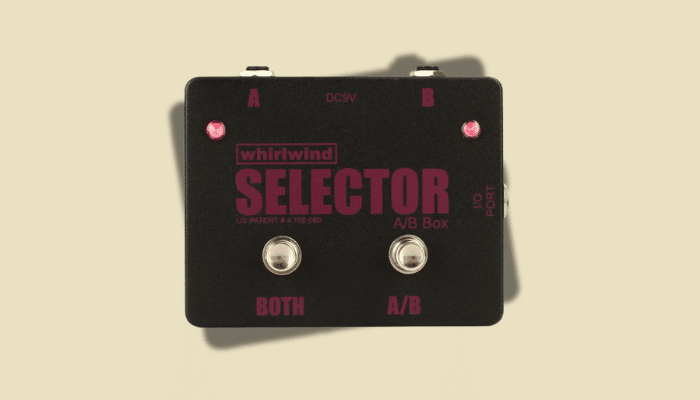
The Whirlwind Selector is the command center of Dave Navarro's pedalboard. This high-quality A/B/A+B switch allows him to alternate seamlessly between his clean and dirty signal chains or even blend both together [2].
What separates the Whirlwind Selector from other switchers is its patented noiseless optical switching, ensuring that transitions between signal paths remain silent and professional. This is crucial for Dave's playing style, which often involves dramatic shifts between clean atmospheric passages and aggressive distorted sections.
MXR Custom Audio Electronics Isolated Power Supply
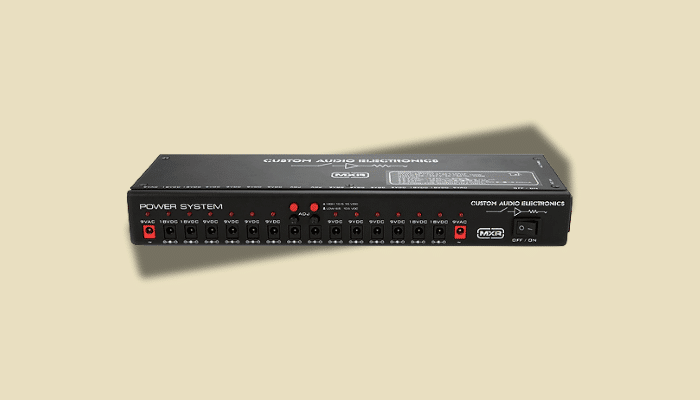
Powering this sophisticated array of pedals is an MXR Custom Audio Electronics isolated power system. This professional-grade power solution provides clean, isolated power to each pedal, eliminating ground loop noise and ensuring optimal performance from every effect.
For a touring professional like Dave Navarro, having reliable, noise-free power is non-negotiable. The isolated outputs prevent pedals from interfering with each other electrically, which is especially important given the multiple delay pedals and digital effects on his board.
Creating Your Own Dave Navarro-Inspired Setup
After looking at Dave Navarro’s pedalboard in detail, you might be wondering how to incorporate some of these ideas into your own rig.
While Dave’s dual-path approach with multiple delays might seem complex, there are some key principles you can apply regardless of your budget or experience level:
- Consider separate signal paths for clean and dirty tones if your playing style demands dramatic contrasts
- Don’t be afraid to use multiple delay pedals with different settings for various sonic textures
- Position your modulation effects strategically to ensure they complement both clean and distorted signals
- Invest in quality utility pedals like tuners and switchers. They’re the key part of any versatile rig
- Pay attention to power supply to minimize noise and maximize pedal performance
What inspires me most about Dave’s approach isn’t just the specific pedals he uses but how he’s organized them to serve his creative vision.
His pedalboard isn’t about showing off an extensive collection. It’s a thoughtfully arranged set of tools that enables his distinctive voice on the instrument.
Whether you’re playing alternative rock, metal, or any style where dramatic tonal shifts are part of your expression, there’s much to learn from how Dave Navarro has structured his effects. The beauty is in the balance: complex enough to create a wide palette of sounds, yet organized in a way that makes those sounds immediately accessible in a live setting.
What aspects of Dave Navarro’s pedalboard will you incorporate into your setup?
The dual-path approach?
The multiple delays?
Or perhaps just the philosophy of choosing effects that truly serve your musical voice rather than following trends?
As with any influential player’s rig, the goal isn’t to copy exactly, but to understand the underlying principles and apply them to enhance your own sound.